Dental Implants in West San Jose / Near Cupertino
Dental implants replace missing teeth with a small post placed into the jawbone, where it takes over the job of the natural tooth root and supports a crown, bridge or denture on top. At Calm Dental Care in San Jose, Dr. Douglas R. Maxson plans and performs the implant placement (surgical phase) and the restoration phase all in one office, using three-dimensional imaging to determine first whether an implant is the right answer for your mouth at all. To find out what your own case would involve, call 408-996-0176 and ask.
By Dr. Douglas R. Maxson, DDS · Calm Dental Care, San Jose, CA
Experience Matters When Choosing Your Implant Dentist
Dr. Douglas R. Maxson has placed more than 8,000 dental implants. When choosing a dentist to replace a missing tooth, experience deserves careful consideration. Implant treatment involves more than placing a fixture — it requires thoughtful evaluation of your bone, gums, bite, and the tooth that will ultimately complete your smile.
Dr. Maxson brings extensive experience to both implant placement and restoration, coordinating your care in one office. For you, that means an experienced dentist guiding the entire process, explaining your options, and planning treatment around your individual needs.
Missing Teeth Affect More Than Your Smile
Most people seek help for missing teeth because of how they affect everyday life. They come in because they have been chewing on one side for two years. Because a front tooth is gone and they have started covering their mouth when they laugh. Because a lower denture lifts when they eat in front of other people, so they order differently at restaurants than they would like to. A missing tooth changes small, daily, ordinary things long before it changes anything a dentist can measure.
The measurable changes do follow, though. The teeth beside the space begin leaning into it. The tooth above or below drifts down toward the opening. The bone that used to hold the missing tooth slowly shrinks, because bone keeps what it is used and loses what it is not. Implants offer a way to replace a single tooth, several teeth, or in carefully selected cases an entire arch, before those changes make the repair more complicated than it needs to be.
If it has been a long time since you saw a dentist, you are in familiar company here. Dr. Maxson treats patients who have postponed dentistry for years, and the approach is deliberately calm and without judgment. Sedation is available if that would make it easier to get started.
Before recommending implant treatment, Dr. Maxson evaluates the whole mouth — the remaining teeth, gums, jawbone, bite, smile line, medical history and long-term maintenance needs. The goal is not simply to place an implant. It is to design a replacement that chews comfortably, looks natural, and can be cleaned and maintained for years.
Quick Answers
- What it is
- A small titanium or ceramic post placed in the jawbone that replaces the root of a missing tooth and supports a crown, bridge or denture.
- Who it helps
- Adults missing one tooth, several teeth, or all the teeth in an arch, who have enough bone or can have bone rebuilt first.
- What it costs
- A single implant with its abutment and crown often falls in the range of $2,650 to $3,250 here, before extraction, grafting, imaging or sedation. You receive a written estimate that names each phase.
- How long it takes
- Commonly several months from placement to the final tooth, because bone needs roughly three to five months to grow around the implant. Some phases can be shortened; the healing itself cannot be skipped.
- Comfort
- Placement is done with local anesthesia. Sedation is available for anxiety, a strong gag reflex, difficulty getting numb, or several procedures in one longer visit.
- Planning
- A 3D CBCT scan is typically taken first to measure bone, locate nerves and sinuses, and design the final tooth before the implant is placed.
- Next step
- A consultation with imaging and a written estimate. Call 408-996-0176. Nothing is scheduled that day unless you want it to be.
What Are Dental Implants?
A dental implant is a small artificial replacement for a tooth root, placed into the jawbone. Most conventional implants are made from titanium or a titanium alloy, though ceramic zirconia systems are available for selected cases. Once the implant is stable within the surrounding bone, it can support a crown, a bridge, a removable denture, or a fixed full-arch restoration.
Implants have become one of the most widely accepted ways to replace missing teeth because they restore support without relying entirely on the neighboring teeth or on a removable appliance. That said, the best treatment still depends on your health, anatomy, bite, bone and restorative goals. An implant is not automatically the right answer for every space, and part of a good consultation is saying so when it is not.
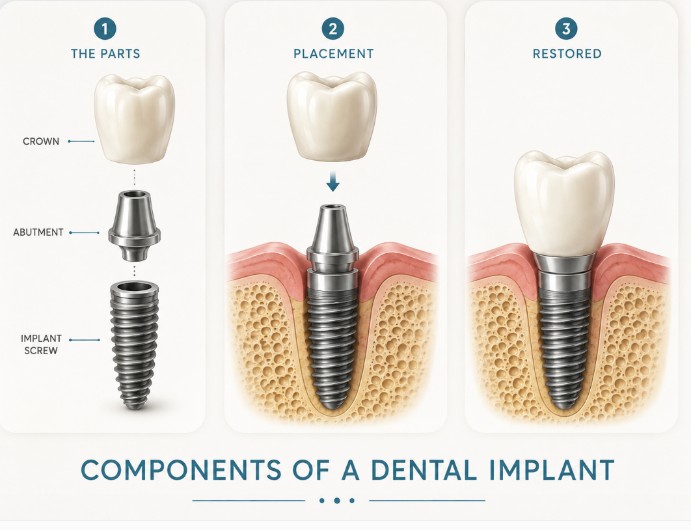
The Three Parts of a Finished Implant
A completed implant generally includes three components: the implant itself within the bone, an abutment or connector, and the visible crown or prosthesis. This is worth understanding before you compare prices anywhere. Patients are sometimes quoted a fee covering only one of the three parts, which is why implant costs can appear dramatically different from one office to another. A useful estimate states plainly what is included and what is not.
Which Type of Implant Restoration Fits Your Situation?
Single-Tooth Implant Crowns
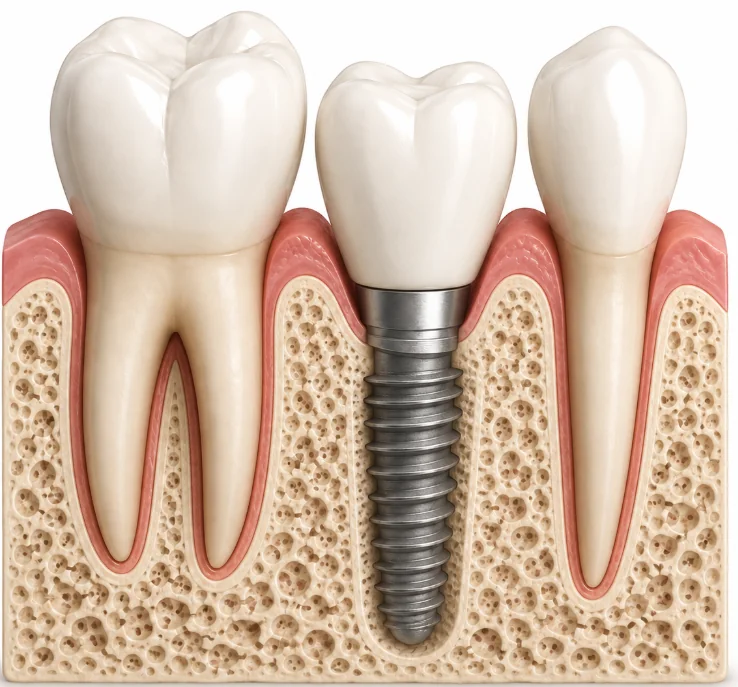
One missing tooth can often be replaced with one implant and one custom crown. Unlike a traditional bridge, this approach generally does not require cutting down the healthy teeth on either side simply to hold a replacement in place. The implant crown is shaped and shaded to blend with the surrounding smile while restoring the space you need to chew comfortably. See also dental crowns.
Multiple-Tooth Implant Bridges
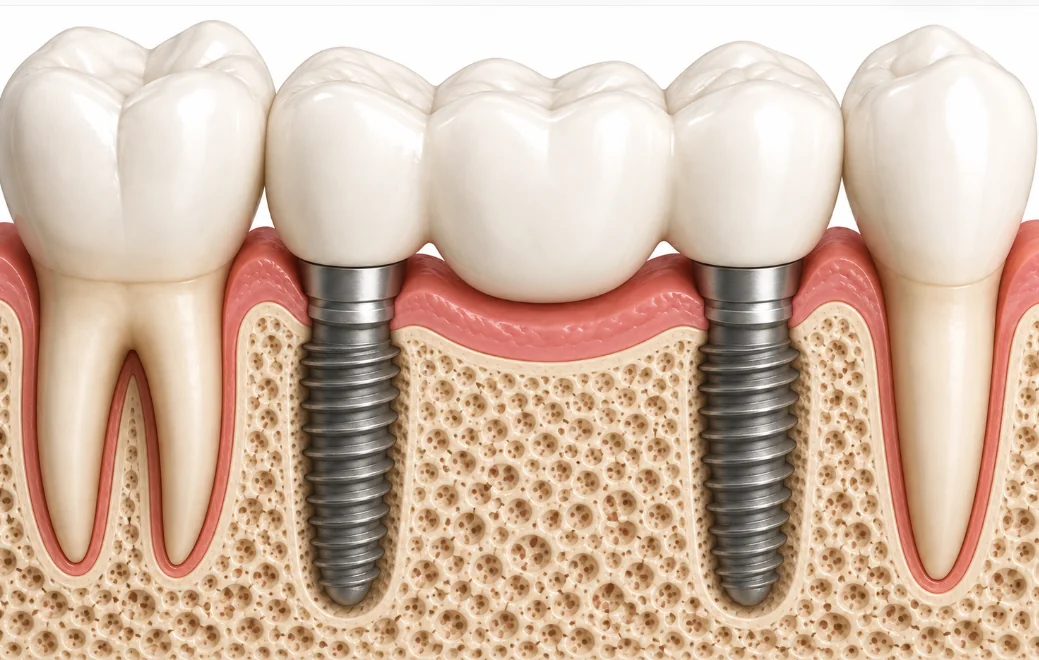
When several adjacent teeth are missing, implants may support a fixed bridge. Not every missing tooth necessarily needs its own implant — two strategically placed implants can sometimes support a three-tooth bridge. Larger spans may require more implants depending on location, available bone, bite forces and the restorative design. The number of implants is a planning decision, not a simple count of missing teeth, and it is one of the more common places where two honest treatment plans for the same mouth will legitimately differ.
Implant-Supported Dentures and Full-Arch Options
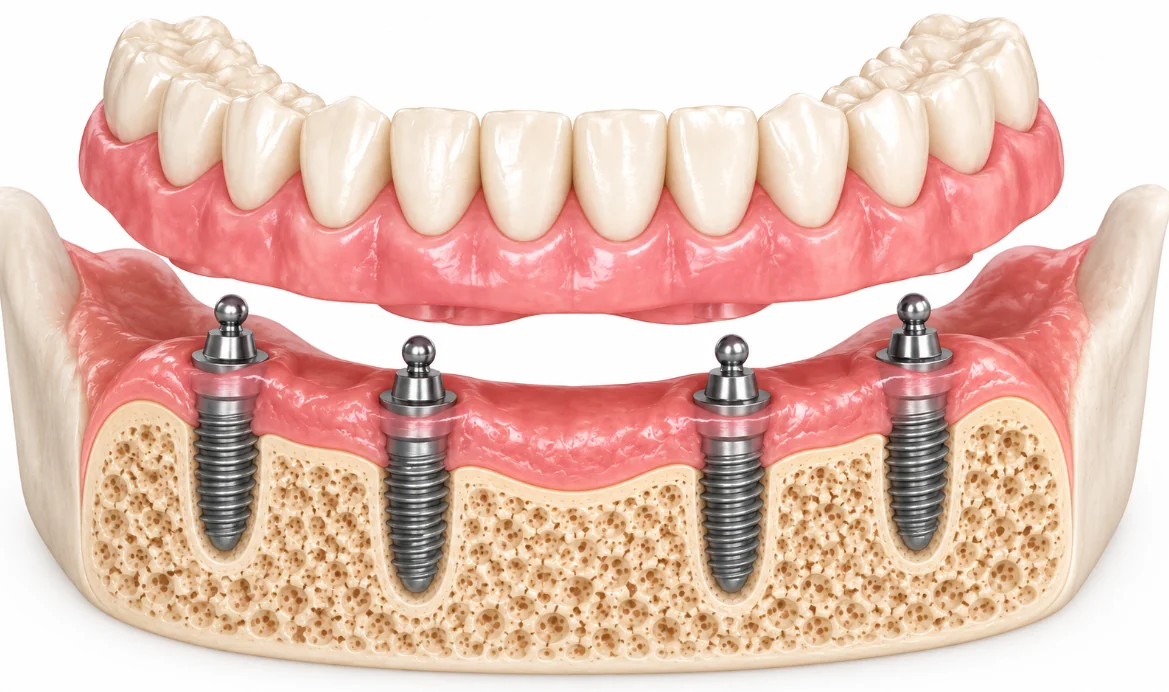
For patients missing most or all of the teeth in an arch, implants can secure a denture so it no longer depends on suction and adhesive, or support a full set of teeth that stays in — one you do not take out at night. Those are two substantially different treatments, with different costs, timelines and maintenance requirements.
Mini Implants
Mini implants are smaller-diameter fixtures used in specific situations, most often to help stabilize a lower denture where bone width is limited. They are not a lower-priced version of conventional implant treatment and they are not appropriate for every case.
Combinations of Fixed and Removable Restorations
Some complex cases use implants to support a fixed section of teeth while another portion remains removable for hygiene or access. These designs are highly individualized. They can be a sound choice when anatomy, lip support, available bone or the number of missing teeth makes a fully fixed restoration less practical.
How Implants Compare With Bridges and Dentures
All three replace missing teeth. They differ in what they rest on, what they ask of the teeth you still have, and what maintenance looks like over time.
| Dental implant | Traditional bridge | Removable denture or partial | |
|---|---|---|---|
| What supports it | The jawbone itself | The natural teeth on either side of the space | The gums and remaining teeth |
| Effect on neighboring teeth | Usually none — healthy teeth are left alone | Those teeth are reduced to hold the bridge | Clasps may rest on them |
| Bone under the space | Chewing forces reach the bone, which helps preserve it | The bone beneath the span is not loaded | The bone beneath is not loaded |
| Timeline | Several months in most cases, because bone must heal around the implant | Typically a few weeks | Typically a few weeks |
| Day-to-day | Brushed and flossed like a tooth; stays in | Cleaned under the span with floss threaders or a brush | Taken out for cleaning |
| Cost pattern | Higher at the start, fewer replacements expected over time | Lower at the start; the whole bridge is replaced if one abutment tooth fails | Lowest at the start; relines and remakes are expected |
Which one is right for you is not a ranking. It is a match to your bone, your health, your bite and your budget, and that is the conversation the consultation is for.
Is There a Cost to Waiting?
Sometimes, and sometimes not. A space that has been stable for years may stay stable. But the longer a tooth is missing, the more the neighboring teeth tend to move and the more the bone under the space tends to shrink, and either one can turn a straightforward implant into one that needs grafting first. Waiting is a reasonable choice. It is worth making on purpose rather than by default.
How Dental Implant Treatment Is Planned
Diagnosis Comes First
Successful implant treatment begins with diagnosis. Dr. Maxson reviews your medical and dental history, examines the proposed implant site, evaluates the bite, and considers how the final tooth needs to look. Dental X-rays are routine, and three-dimensional imaging may be recommended to evaluate bone dimensions and nearby structures such as nerves and sinuses.
Digital planning or a surgical guide may be used to position the implant so the future crown emerges in the right place. That order matters more than it sounds. An implant can be perfectly stable in bone and still be difficult to restore if it sits at an unfavorable angle or depth, which is why the final tooth is designed before the implant is placed rather than after.
Three-Dimensional CBCT Planning
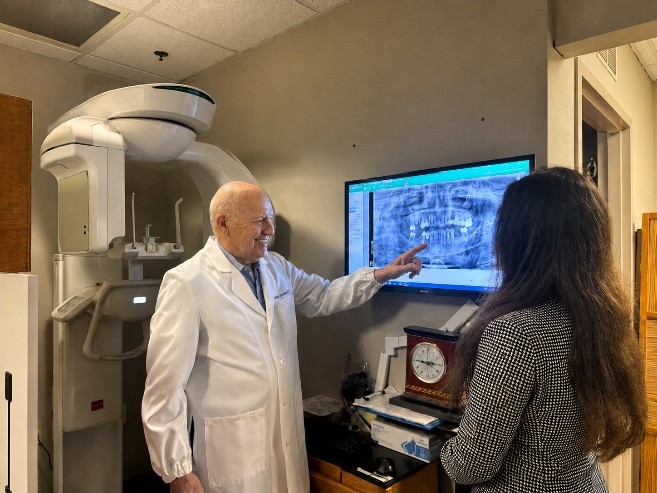
At Calm Dental Care, a cone beam computed tomography scan — a 3D CBCT scan — is typically obtained before implant treatment. The scan allows Dr. Maxson to evaluate bone height, width and density, identify the position of important nerves (particularly in the lower jaw), assess the maxillary sinuses, and determine whether grafting or a sinus lift may be needed.
That three-dimensional information also guides implant selection, placement depth and angulation. When these safety and restorative questions are worked out in advance, placement becomes more predictable and may support a smoother recovery and an earlier progression to the final crown. Learn more about our digitally planned implant dentistry.
Sites Where the Tooth Has Been Missing a While
If a tooth has been gone six months or longer, the site is approached a little differently, because the ridge may have changed in height or width since the extraction. CBCT imaging helps determine whether enough bone remains for direct placement, or whether rebuilding the ridge where the tooth used to be should come first. Bone loss does not automatically rule out implant treatment. More often it changes the sequence and the timeline. Our bone grafting page explains what those procedures involve.
After placement, Dr. Maxson commonly allows approximately three to five months for bone to integrate around the implant fixture. Healing time varies with age, bone density, medical health, medications and where the implant sits in the jaw.
One-Stage, Two-Stage and Immediate Implant Treatment
Implants may be managed using different surgical protocols. In a two-stage approach, the implant is covered by gum tissue during early healing and uncovered later so a healing abutment can be attached. In a one-stage approach, a healing component remains visible through the gum while the implant integrates.
An immediate implant is placed at the same appointment as the tooth extraction. In a suitable site this can reduce the number of surgical visits, but it still requires adequate bone, appropriate infection control and sufficient initial stability. Immediate loading is a separate question: that term means a temporary tooth is attached shortly after placement. A patient may qualify for immediate placement without qualifying for immediate loading, and the difference is worth clarifying before treatment begins.
Placing the Abutment and Final Crown
After the integration period, the healing cap or cover screw is removed. Sometimes the implant has been left covered by gum tissue while it heals, especially after grafting; when that is the case, a small opening is made to uncover it at the next visit. It is a brief step, often completed with a small diode laser, and it is done with local anesthetic.
An abutment — the post that connects the implant to the restoration — is then secured to the fixture. A digital scan or traditional impression is taken and sent to the dental laboratory, where the implant crown is fabricated through a process similar to a crown on a natural tooth. A temporary tooth is normally provided for visible areas when appropriate.
The final crown, bridge or denture is commonly returned by the laboratory in approximately two weeks. Dr. Maxson then evaluates fit, bite, appearance and — importantly — whether the restoration can actually be cleaned, before it is delivered.
Comfort, Sedation and Recovery
Implant surgery is usually performed with local anesthesia. Patients commonly describe pressure or vibration during treatment rather than sharp pain. Tenderness, swelling or bruising can follow. Many people return to routine activities quickly after a straightforward single-implant procedure, while larger grafting or full-arch cases generally require more recovery time.
Sedation is available for patients who are anxious, have a strong gag reflex, have difficulty getting numb, or would like several procedures completed in one longer visit. Dr. Maxson reviews which level of sedation may be appropriate based on the procedure and your medical history, along with medication instructions, escort requirements and post-appointment restrictions. Our sedation dentistry page explains the options in full.
Why Front-Tooth Implants Are Technically Demanding
Replacing a tooth in the visible smile zone is not only a bone problem. The shape and height of the gum tissue, the small gum triangles between the teeth, the contour of the crown and the exact position of the implant all affect the final appearance. Where gum or bone tissue is deficient, grafting or tissue-shaping procedures may be recommended to create a more natural result. This is an area where planning time and restorative judgment show up directly in how the finished tooth looks in the mirror.
Understanding Dental Implant Fees
Implant fees vary because implant treatment varies. The total depends on the number of implants, whether an extraction is needed, whether grafting is involved, imaging, sedation, temporary restorations, abutments and the final crown, bridge or denture. Two estimates for the same mouth can look very different simply because they include different phases.
As a general starting point, a single implant with its abutment and crown often falls in the range of $2,650 to $3,250 at Calm Dental Care, before any extraction, grafting, imaging or sedation your particular case may require. That figure is a starting point for the conversation, not a quote for your mouth.
For that reason, Calm Dental Care provides a written estimate identifying each phase of treatment, so you can compare actual treatment rather than incomplete starting prices. Dr. Maxson would rather discuss real numbers early than have a patient discover additional components later.
Dental insurance sometimes contributes toward part of implant treatment, and coverage differs widely between plans. Our financial policies page outlines payment and financing options, and our team is glad to review your specific benefits before you commit to treatment.
Why Choose Dr. Douglas R. Maxson for Implant Care?
Dr. Maxson began formal postgraduate implant education in 1999 by completing the year-long Implant Continuum at the University of the Pacific School of Dentistry. He later earned Diplomate status through the International Congress of Oral Implantologists, a credential requiring extensive documented implant experience across both the surgical and restorative phases of treatment. His credentialing included the submission of 250 successful implant cases involving single and multiple implants, along with completed crowns, bridges and dentures supported by implants. Since 1999 he has placed and restored several thousand dental implants.
His additional implant education and professional involvement include membership in the American Academy of Implant Dentistry, graduation from the California Academy of Implant Dentistry, implant training through the Las Vegas Institute for Advanced Dental Studies, and the Glidewell Laboratory implant course series. Dr. Maxson also founded and directs the San Jose Implant Continuum, where he supervises and trains dentists throughout California, and he has served on the faculty of the Ken Judy Caribbean Dental Institute, which provides implant education to dentists in Jamaica and elsewhere.
Dr. Maxson brings more than 40 years of clinical experience to treatment planning. That experience matters because implants do not exist in isolation — their success depends on the condition of the bite, the gums, the neighboring teeth, the existing dentistry and the final restorative design.
What That Means for Your Treatment
- Decades of experience evaluating complex restorative and implant cases
- A whole-mouth approach that weighs function, appearance and long-term maintenance
- Both the surgical and restorative phases planned and performed under one roof
- Sedation options for patients who want a calmer, more comfortable experience
- Careful discussion of alternatives, risks, timing and expected fees before treatment begins
- Written estimates that identify each phase, rather than a single teaser number
- A San Jose location within easy reach of the South Bay and the Peninsula
Related Topics
These pages cover the adjacent parts of implant treatment: the bone that supports an implant, the denture an implant can hold, and the sedation options that keep a long visit calm.
What Patients Say About Their Implant Treatment
“I highly recommend Dr. Douglas Maxson. I went through extraction, implant placement, and jawbone work, and the entire process was handled with precision and expertise. The results exceeded my expectations — both functionally and aesthetically.”
“For over 20 years Dr. Maxson had treated me and my children to braces, cavities, implants, cleanings and wisdom teeth extractions. We're very satisfied with his professionalism and special care.”
Dental Implant FAQs
What happens at my first visit?
We look, we take the images we need, and we talk. Dr. Maxson will tell you what he sees, which options are realistic for your mouth, and what each one involves in time and money. You leave with a written estimate. Nothing is scheduled that day unless you want it to be.
How much do dental implants cost in San Jose?
The fee depends on the number of implants and on whether extractions, grafting, imaging, sedation, temporary restorations and abutments are part of the plan. A single implant with its abutment and crown often falls in the range of $2,650 to $3,250 here, before any of those additional steps. A complete written estimate should identify each phase, so you are comparing actual treatment rather than an incomplete starting price.
Am I a candidate for dental implants?
Many adults are. The answer depends on bone, gum health, medical history, medications, smoking, oral hygiene, grinding forces and the restoration being planned. Bone loss does not automatically rule out treatment. More often it changes the plan or the sequence rather than the answer.
Do dental implants hurt?
Local anesthesia is used during surgery, and sedation is available. Patients commonly describe pressure or vibration during treatment rather than sharp pain. Tenderness afterward varies with the extent of the procedure, though many single-implant patients describe the recovery as manageable.
How long do dental implants last?
Implants are intended as long-term treatment, but no implant can be guaranteed for life. Longevity depends on hygiene, gum and bone health, bite forces, smoking, medical factors and professional maintenance. The implant and the crown should be considered separately, because a crown may wear or need replacement while the implant beneath it stays healthy.
How long does the whole process take?
A straightforward case may take several months from placement to final restoration. Extraction healing, bone grafting or more complex reconstruction extends the timeline. Immediate placement or a temporary tooth may shorten certain phases, but neither eliminates the biological healing an implant requires.
What is the recovery time after implant surgery?
Many patients resume light activities within a day or two after a straightforward procedure. Larger surgeries require longer. Dr. Maxson provides individualized instructions covering diet, activity, medications and oral hygiene.
What is the difference between implants, bridges and dentures?
Implants are anchored in the jawbone and stand on their own. Traditional bridges are supported by the neighboring teeth, which have to be reduced to hold the bridge. Dentures are removable and rest on the gums, though implants can be added to improve how well a denture is held in place.
What are the risks or complications of dental implants?
Possible problems include infection, slow healing, an implant that does not bond to the bone, gum or bone loss around it, injury to a nearby nerve or the sinus, a component that loosens or fractures, damage from clenching or grinding, and a result that does not look the way you hoped. Careful assessment, sterile technique, sound planning and regular maintenance all reduce risk, and your individual risk should be discussed before treatment begins.
Ten Questions Worth Bringing to Your Consultation
Implant treatment is far easier to compare when you ask the same questions of everyone you consult. These are the ten that most often change a decision. Bring them with you — here, or anywhere else you go.
- What exactly is included in the quoted fee, and what is not?
- Can the implant be placed at the same appointment as my extraction?
- Will I have a temporary tooth while the implant heals, and how long would I be without one?
- Do I need three-dimensional imaging, and what will it show?
- Can I be sedated, and what would that involve before and after the visit?
- Who plans and performs the surgical phase, and who does the restorative phase?
- What alternatives should I consider, and why is this plan the recommendation?
- How do smoking, grinding or my medical history affect my chances of success?
- What happens if an implant does not integrate, and can it be replaced?
- What maintenance and costs should I expect over the next ten years?
Schedule a Dental Implant Consultation
The most important implant decision is not which advertisement sounds fastest or cheapest. It is choosing a treatment design that fits your anatomy, your health, your bite, your appearance goals and your budget.
Contact Calm Dental Care in San Jose to schedule an implant consultation with Dr. Douglas R. Maxson. Bring your questions — including the ten above, and whatever else has been sitting on your mind. Call 408-996-0176 or request a consultation online, and Dr. Maxson will tell you what he sees, which options are realistic for your mouth, and what each one would cost, before you decide anything.
Not ready to book? Call and ask what a complete implant estimate should include. We will walk you through it whether or not you are treated here.
If a tooth is broken or painful right now: Call 408-996-0176. A tooth that has to come out is also the moment when placing an implant at the same visit is most often possible.
Clinically reviewed by Dr. Douglas R. Maxson, DDS · Diplomate, International Congress of Oral Implantologists · Last updated October 1, 2026