What Is Gum Disease?
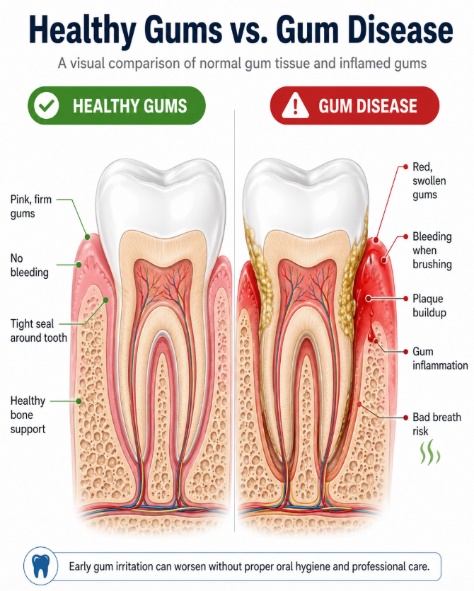
Gum disease is a bacterial infection of the gums and the bone that support your teeth. It begins as gingivitis — red, puffy gums that bleed easily — and, if untreated, can progress to periodontitis, where the infection spreads below the gumline and destroys bone. That leads to gum recession, loose teeth, and eventually tooth loss.
Gum disease is common. National estimates suggest that roughly 42.2% of adults age 30 and older have some form of periodontal disease (NIDCR).
What Are the Signs of Gum Disease?
See a dentist if you notice any of these warning signs:
- Gums that bleed when you brush or floss
- Red, swollen, or tender gums
- Bad breath that does not go away
- Gums pulling away from the teeth, making teeth look longer
- Loose teeth or a change in how your teeth fit together
These symptoms can point to gum disease, but only an exam can diagnose it. The earlier it is caught, the more of your natural smile we can protect.
Why Does Treating Gum Disease Matter?
Untreated gum disease is a leading cause of tooth loss in adults. As the infection advances, it destroys the bone and tissue that anchor your teeth — and bone loss cannot be reversed once it happens.
- Advanced gum disease can loosen teeth and lead to tooth loss — and when teeth are lost, dental implants can replace them.
- Research has linked periodontal disease with conditions such as diabetes and heart disease (source).
- Gingivitis is reversible; periodontitis can be controlled but not undone — so timing matters.
- Treatment helps at any stage, and it is never too late to improve your gum health.
What Periodontal Treatments Do You Offer?
Your plan depends on how far the disease has progressed. Most gum disease is treated without surgery.
Scaling and Root Planing (Deep Cleaning)
A non-surgical cleaning that removes plaque and tartar from below the gumline and smooths the root surfaces so the gums can heal and reattach. Best for early to moderate gum disease; usually done in 1-2 visits with local anesthesia.
Periodontal Maintenance
After active treatment, specialized cleanings every 3-4 months keep the infection controlled and monitor pocket depths. This is what keeps results stable over time.
Advanced and Surgical Care
For deep pockets or significant bone loss, procedures such as gum grafting, pocket reduction, or bone grafting may be recommended.
Regular Cleaning vs. Periodontal Maintenance
| Feature | Regular cleaning | Periodontal maintenance |
|---|---|---|
| Purpose | Removes plaque and tartar above the gumline; keeps healthy mouths healthy | Controls active or past gum disease below the gumline |
| Frequency | Typically, every 6 months | Usually, every 3-4 months |
| Includes | Polishing and a routine check | Pocket-depth charting and below-gumline cleaning |
Will Treatment Hurt? Comfort and Sedation
Most periodontal treatment is done with local anesthesia, and any soreness afterward is usually mild and short-lived. For patients who feel anxious, sedation options such as nitrous oxide or oral sedation may be available — see our sedation options in San Jose. Your dentist will discuss which comfort option fits your treatment and medical history.
What to Expect at Your Visit
- 01
Exam and charting
We measure the pockets around your teeth and review X-rays to stage the disease.
- 02
Diagnosis and plan
We explain what we found and outline your options and timeline.
- 03
Active treatment
Deep cleaning or other prescribed care, scheduled over 1-4 visits, depending on the severity of the disease and your availability.
- 04
Maintenance
We transition you to a 3-4-month cleaning schedule to protect your results.
Why Choose Dr. Douglas R. Maxson for Your Periodontal Treatment?
Diagnosing and treating gum disease has been a focus of Dr. Maxson’s care throughout his practice career. His background in periodontal health goes well beyond a general dental degree:
- Named outstanding periodontal student in his senior year at the University of Minnesota School of Dentistry.
- Studied under Robert Barkley, a pioneer of the preventive dentistry movement who helped bring the benefits of flossing to both the profession and the public.
- Contributed to the periodontal continuum at the University of the Pacific School of Dentistry for ten years, studying with the chair of its periodontics department.
- Completed postgraduate study in the periodontics and implant continuum at the USC School of Dentistry.
- Directs the San Jose Implant Continuum, where he teaches periodontal grafting and implant periodontics.
Because his practice emphasizes preventive maintenance alongside both surgical and nonsurgical care, his patients tend to keep their gums healthy over the long term. Meet Dr. Douglas R. Maxson.
Cost, Insurance, and Financing
The cost of periodontal treatment depends on how much of the mouth is affected and which procedures you need. Dental insurance often covers a portion of periodontal care, and our team can help you understand your benefits before treatment begins. We also offer financing options such as CareCredit and an in-office patient membership plan — see insurance and financing. We will review your estimated costs with you before any treatment starts — no surprises.
Ready to Protect Your Smile?
Get a clear picture of your gum health and a plan to keep your teeth.
Not sure if you need treatment?
Send us your symptoms and we will help you decide, or request a consultation.
Request an AppointmentSevere gum pain, swelling, or a loose tooth?
Call 408-996-0176 — we reserve time for urgent care.
Call NowFrequently Asked Questions
Can gum disease be reversed?
+
Gingivitis, the early stage, can often be reversed with a professional cleaning and good home care. Once periodontitis has caused bone loss, that damage cannot be undone — but treatment can stop the disease from progressing and keep your teeth stable.
Does periodontal treatment hurt?
+
Treatment is done with local anesthesia, so you should not feel pain during the procedure. Mild sensitivity for a few days afterward is normal and is usually managed with over-the-counter pain relievers.
How long does treatment take?
+
A non-surgical deep cleaning is typically completed in 1-2 visits. After that, most patients continue with maintenance cleanings every 3-4 months to keep the disease controlled.
Will my insurance cover periodontal treatment?
+
Many dental plans cover part of periodontal care. Our team can verify your benefits and explain your estimated out-of-pocket cost before treatment begins.
What is the difference between a regular cleaning and a deep cleaning?
+
A regular cleaning removes buildup above the gumline. A deep cleaning — scaling and root planing — reaches below the gumline to remove the infection where gum disease actually lives.
What happens if I don't treat gum disease?
+
Untreated gum disease continues to destroy the bone and tissue that support your teeth, which can lead to loose teeth and tooth loss. It has also been linked to conditions such as diabetes and heart disease.
How soon should I be seen?
+
Sooner is better. Early treatment means more options and a better outcome, so it is best to be evaluated within a couple of weeks of noticing symptoms such as bleeding or swollen gums.
Author: Dr. Douglas R. Maxson, DDS · Clinically reviewed by: Dr. Douglas R. Maxson, DDS · Last updated: October 1, 2026