Partial, Full & Implant-Supported Dentures in San Jose
More comfortable chewing. A more confident smile. Options that fit your life.
Missing teeth can change everyday decisions: what you order, how you speak, and whether you smile in photographs. A loose denture can bring its own frustrations, especially when it shifts during meals or conversation.

At Calm Dental Care in San Jose, California, Dr. Douglas R. Maxson helps patients explore partial dentures, complete dentures, and implant-supported replacement teeth. Your recommendation depends on your remaining teeth, gums, bone support, bite, and priorities.
Whether you need your first denture or want greater stability from an existing one, we begin by understanding what you want to improve.
What is a partial denture?
A partial denture replaces several missing teeth when some natural teeth remain in the upper or lower jaw. It can replace teeth in different areas of the same arch.
A conventional removable partial typically has replacement teeth attached to a gum-colored base, sometimes supported by a metal framework. Clasps or other attachments help hold it in position around selected natural teeth.
A partial may restore chewing surfaces and fill visible gaps without replacing every tooth. Its design must also account for the health of the teeth supporting it.
- Benefits: It can replace multiple teeth with one removable appliance and may cost less initially than several implant restorations.
- Tradeoffs: Some clasps may be visible, and the appliance takes practice to insert, remove, and wear. Daily cleaning of both the partial and your natural teeth is essential.
What is a full denture?
A full denture, also called a complete denture, replaces all teeth in the upper or lower arch. It may be needed for one jaw or both.
Conventional complete dentures rest on the gums and underlying ridge. An upper denture generally covers the palate, while a lower denture has a horseshoe shape to accommodate the tongue.
Dentures can restore facial support, appearance, and everyday function. However, they do not provide the same anchorage as natural teeth. Lower dentures can be especially challenging to stabilize because of tongue movement and a smaller supporting surface.
As gums and bone change, adjustments, relining, or replacement may become necessary.
How can implants stabilize a partial or full denture?
Dental implants are placed in the jawbone to provide attachment or support for replacement teeth. Depending on the design, they can help a partial or complete denture resist lifting, sliding, and rocking.
An implant-assisted removable partial may use strategically positioned implants to improve stability, particularly where back teeth are missing. A full-arch restoration can also connect to implants.
Greater stability can make chewing feel more predictable. However, implants alone do not guarantee a balanced bite. The replacement teeth must also be designed and adjusted to work with the opposing teeth.
Some removable overdentures share support between implants and gums; others receive more support from implants. Dr. Maxson will explain the proposed design.
Removable implant dentures: secure, with easier access for cleaning
A removable implant denture, often called an implant overdenture or snap-in denture, attaches to implants but is removed by the patient for cleaning.
Potential advantages
Removing the denture provides direct access to its underside, the implant attachments, and surrounding tissues. This can simplify daily hygiene.
Implant attachments can reduce movement and reliance on adhesive. Removable designs may also help replace lost gum volume and provide lip support.
Considerations
You still remove the appliance as instructed, usually overnight. Attachment components can wear and require replacement. Some designs continue to rest partly on the gums and may need relining.
You also need enough hand coordination to seat and remove the denture correctly.
Fixed implant teeth: stay in place between visits
A fixed implant-supported full-arch restoration is secured to implants and is not removed by the patient. It may be described as a fixed implant denture or full-arch implant bridge. Your dentist can remove it when clinically necessary.
Potential advantages
The teeth remain in place during daily activities and overnight. For suitable patients, this can provide a secure alternative to taking a denture in and out.
Certain designs leave the palate uncovered, which some patients prefer.
Considerations
Cleaning beneath fixed teeth requires specific tools and consistent technique. Fixed does not mean maintenance-free.
These restorations generally involve a greater financial investment. Repairs and professional servicing may be more involved, and the design must accommodate your bone, gum contours, speech, and facial support.
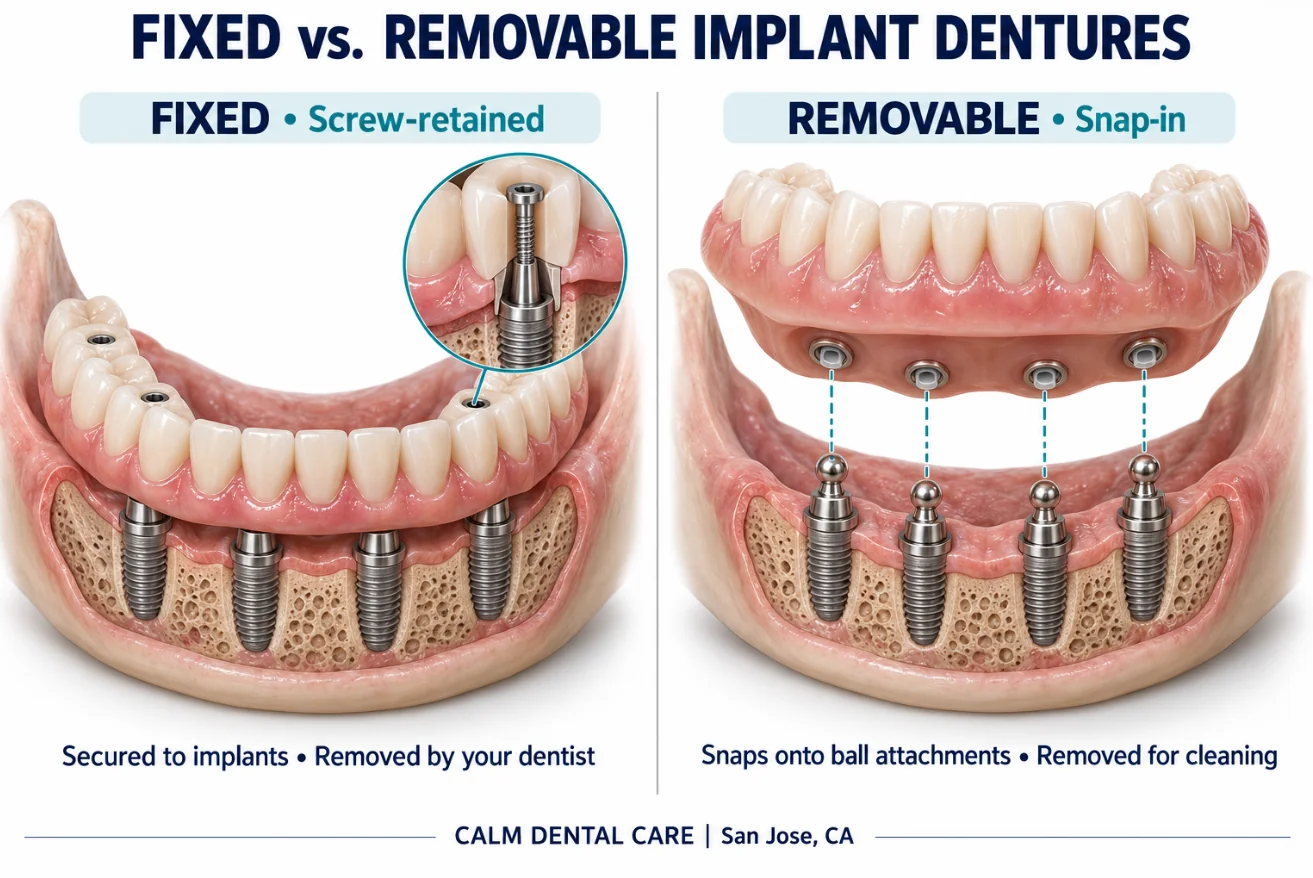
Fixed or removable: which is right for you?
Neither option is best for everyone. Consider:
- Cleaning: Can you reliably clean beneath fixed teeth?
- Handling: Are you comfortable removing and reseating an appliance?
- Anatomy: How much bone and soft-tissue support is available?
- Appearance: What design supports your smile and lips?
- Budget: What are the initial and ongoing maintenance costs?
Dr. Maxson will help you compare appropriate options. The number and placement of implants depend on the jaw, available bone, and restoration—not a universal “two to four implants” rule.
What does treatment involve?
Your evaluation includes your concerns, medical history, remaining teeth, gums, and bite. Imaging is used when needed for implant planning.
Treatment may involve impressions or digital scans, evaluating tooth shape and position, fittings, and adjustments. If extractions are needed, ask whether an immediate denture could provide replacement teeth during healing. It may require later relining or replacement.
Implant treatment includes surgery and healing. Bone grafting may be necessary in some cases. Dr. Maxson coordinates surgical and restorative implant care at Calm Dental Care and will explain the sequence, costs, and appropriate comfort options.
Frequently asked questions
Can my current denture attach to implants?
Sometimes. Its fit, condition, design, and available space must be evaluated. A new denture may be more appropriate.
How long does treatment take?
Timing varies with extractions, healing, grafting, and implant placement. You will receive an individualized plan.
Do I still need checkups without natural teeth?
Yes. Your gums, oral tissues, implants, and denture fit still need professional evaluation.
Ready for a more comfortable smile?
Call Calm Dental Care at (408) 996-0176 or request an appointment with Dr. Douglas R. Maxson in San Jose, CA. We will help you compare your options and understand your next step.