Emergency Dentistry in West San Jose / Near Cupertino
Dental emergencies don't wait, and neither should you. If you're in pain, call us right away — we do everything we can to see emergency patients the same day.
What counts as a dental emergency?
If you are in severe pain, have facial swelling, have broken a tooth, or have had one knocked out, call (408) 996-0176 now. Severe toothaches, broken or cracked teeth, knocked-out teeth, lost crowns or fillings, abscesses and swelling, and injuries to the gums or jaw all warrant prompt care. Calm Dental Care holds time for same-day dental emergencies in San Jose, and after-hours calls are forwarded to Dr. Douglas R. Maxson — so you reach the dentist, not a message service. No referral is needed, and new patients are welcome. If you're unsure, call — we'll help you decide how quickly you need to be seen.
What to do right now
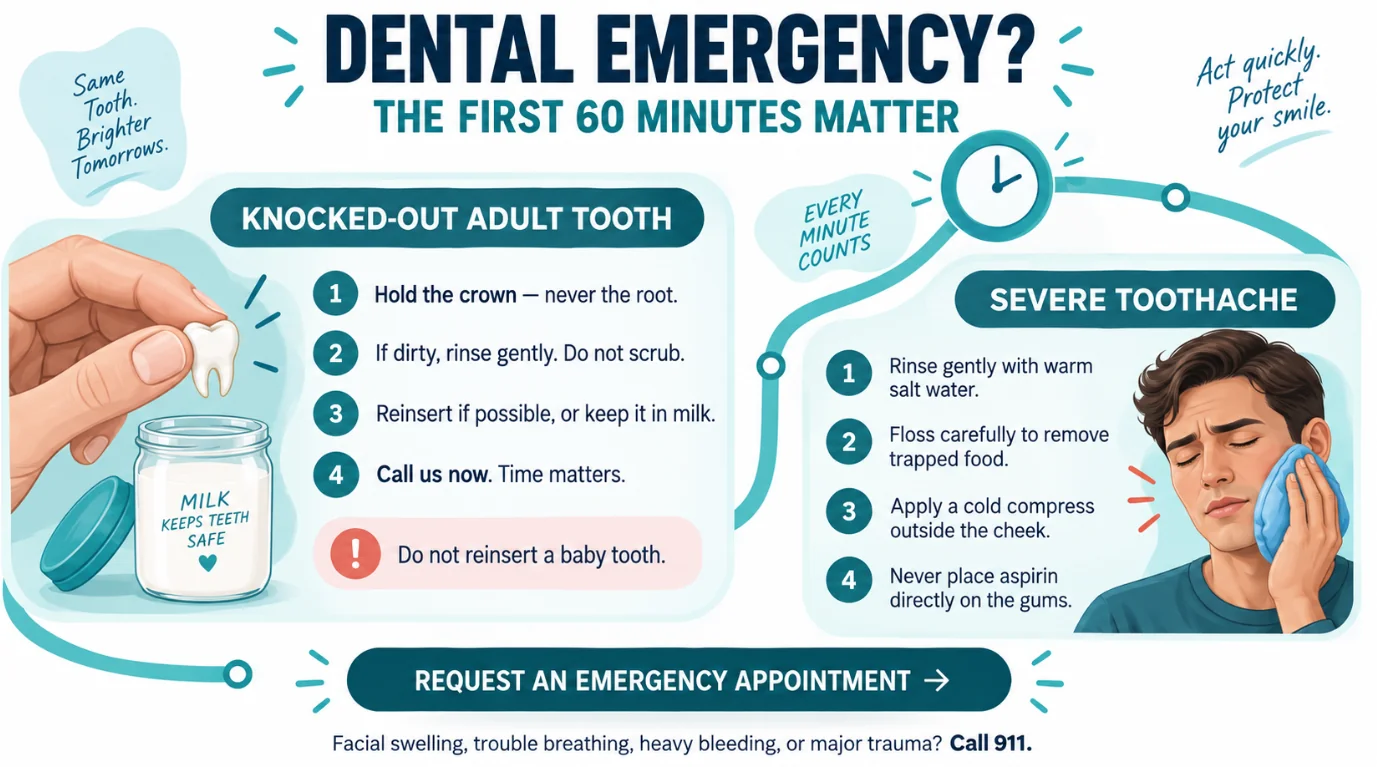
For a knocked-out tooth, handle it by the crown (not the root), rinse it gently, and keep it in milk or inside your cheek — then get to us within the hour if possible. For pain and swelling, a cold compress and over-the-counter pain reliever can help until you arrive.
A broken or cracked tooth
- Save the pieces. Keep any fragment and bring it with you — a broken front corner can often be bonded back on, and the original piece matches better than anything we could build.
- Rinse with warm water. If a sharp edge is cutting your tongue or cheek, cover it with dental wax or sugar-free gum until you are seen.
- Cold compress for swelling. On the outside of the face, not against the tooth.
Facial swelling or a suspected abscess
Call immediately rather than waiting to see whether it settles. Swelling means infection has left the tooth and is moving into the surrounding tissue. Re-read the safety box at the top of this page — fever, difficulty swallowing, trouble breathing or swelling that keeps spreading means the emergency room, not an appointment tomorrow.
A lost filling, crown or bridge
Keep the restoration and bring it with you; it can often be re-cemented. Do not try to glue it back yourself — household adhesives are not safe in the mouth and can make the tooth impossible to restore properly. If the exposed tooth is sensitive, keep it clean and avoid chewing on that side until you are seen. There may be times we suggest cleaning a crown that has popped off and suggest attempting to place it back on the tooth.
Bleeding after an extraction
Fold clean gauze into a pad, place it over the socket and bite firm and steady for twenty minutes without checking it — lifting the pad to look restarts the clock. A moistened tea bag works if you have no gauze. If bleeding continues after two proper attempts, call us.
Four Things Most People Don’t Know
When the pain suddenly stops, that is not good news
A severe toothache that disappears on its own usually means the nerve inside the tooth has died, not that the tooth has healed. Teeth do not heal themselves. The pain signal stops because the tissue sending it is gone, while the infection underneath carries on into the bone. People who wait at this point often return weeks later with facial swelling, and by then the treatment is bigger.
Swelling in the lower face can become an airway problem
An infection from a lower tooth can spread into the tissue spaces of the neck — a condition called Ludwig’s angina — and press on the airway. It is uncommon, and it is a genuine medical emergency when it happens. Facial swelling with difficulty breathing, difficulty swallowing or trouble opening your mouth is a hospital visit, immediately.
The emergency room and the dentist do different jobs
Hospital emergency departments are the right place for facial trauma, a suspected broken jaw, airway swelling and serious systemic infection, and they can give you pain relief and antibiotics. What most of them cannot do is treat the tooth — they are generally not staffed or equipped to replant a tooth, perform a root canal or recement a crown. So, an ER visit for a straightforward dental problem often ends with you still needing a dentist the next day. Knowing which one you need saves a night. Contact us for advice.
Do not throw the broken piece away
If a front tooth chips, the fragment is worth keeping. Modern bonding materials can sometimes reattach the natural piece, and nothing matches your enamel quite like your own enamel. Put it in milk or saline, or a small sealed container, and bring it in.
Preventing the Next One
- A custom sports mouthguard. A fitted guard protects against chipped, displaced and knocked-out teeth far better than a boil-and-bite from a sporting goods store, mainly because people actually wear one that fits.
- A nightguard if you grind. Clenching and grinding crack teeth slowly and then all at once, usually in a molar that has a large filling in it.
- A small dental first-aid kit. Gauze, dental wax, a temporary filling material, salt packets, a cold pack — and our number, 408-996-0176, saved in your phone before you need it.
Why Call Dr. Douglas R. Maxson
Most emergency pages promise same-day care. Fewer can tell you who answers the phone at nine on a Saturday night. Here, after-hours calls go to Dr. Maxson, who brings 35+ years of clinical experience to working out what is actually wrong.
- Same-day emergency appointments held each day
- After-hours calls forwarded to the dentist, not an answering service
- 3D cone beam imaging in the office when the situation needs more than an X-ray
- Sedation available for patients who are anxious or in significant pain
- Treatment and fees explained before anything is started
- New patients welcome, no referral needed, second opinions welcome
- A calm, nonjudgmental approach — nobody here is going to lecture you about why you waited
Calm care when you need it most
Emergencies are stressful enough. Our team will get you comfortable first, explain exactly what's happening, and treat the problem — with sedation available if you're anxious or in significant pain.
Ready to feel calm about dentistry?
Call our San Jose office or request an appointment online — we will take care of the rest.