Wisdom Teeth Removal in San Jose, CA
Understand your options. Plan your care. Feel more comfortable.
Wisdom teeth often appear during the late teens and early twenties—just when school, work, and life are getting busy. Some come through normally and remain healthy. Others grow at an angle, stay trapped beneath the gums, or emerge only partway, creating areas that are difficult to clean.

At Calm Dental Care in San Jose, California, Dr. Douglas R. Maxson evaluates your wisdom teeth and explains whether monitoring or removal makes sense. If extraction is recommended, sedation options ranging from nitrous oxide to IV moderate sedation can help make treatment more comfortable.
You do not have to wait for swelling or a painful weekend to find out what is happening.
What are wisdom teeth?
Wisdom teeth, also called third molars, are the last teeth at the back of the mouth. They commonly emerge around ages 17–25, although timing varies. Some people develop fewer than four, and others never develop them.
A wisdom tooth is impacted when it cannot fully emerge into its normal position. It may remain beneath the gum, be enclosed in bone, or come through only partially.
Impaction alone does not explain every treatment decision. Position, cleanliness, disease, neighboring teeth, and the risks of removal all matter.
Does everyone need wisdom teeth removed?
No. Wisdom teeth that are healthy, functional, properly positioned, and cleanable may be kept with regular monitoring.
Removal may be recommended when a tooth has disease, repeatedly causes problems, or presents a significant risk to surrounding structures. A tooth that does not hurt can still have decay, gum disease, or other changes that require evaluation.
Dr. Maxson will explain the findings and the reasons for his recommendation. When observation is appropriate, follow-up examinations and imaging when indicated help monitor changes.
Why wisdom teeth can cause trouble
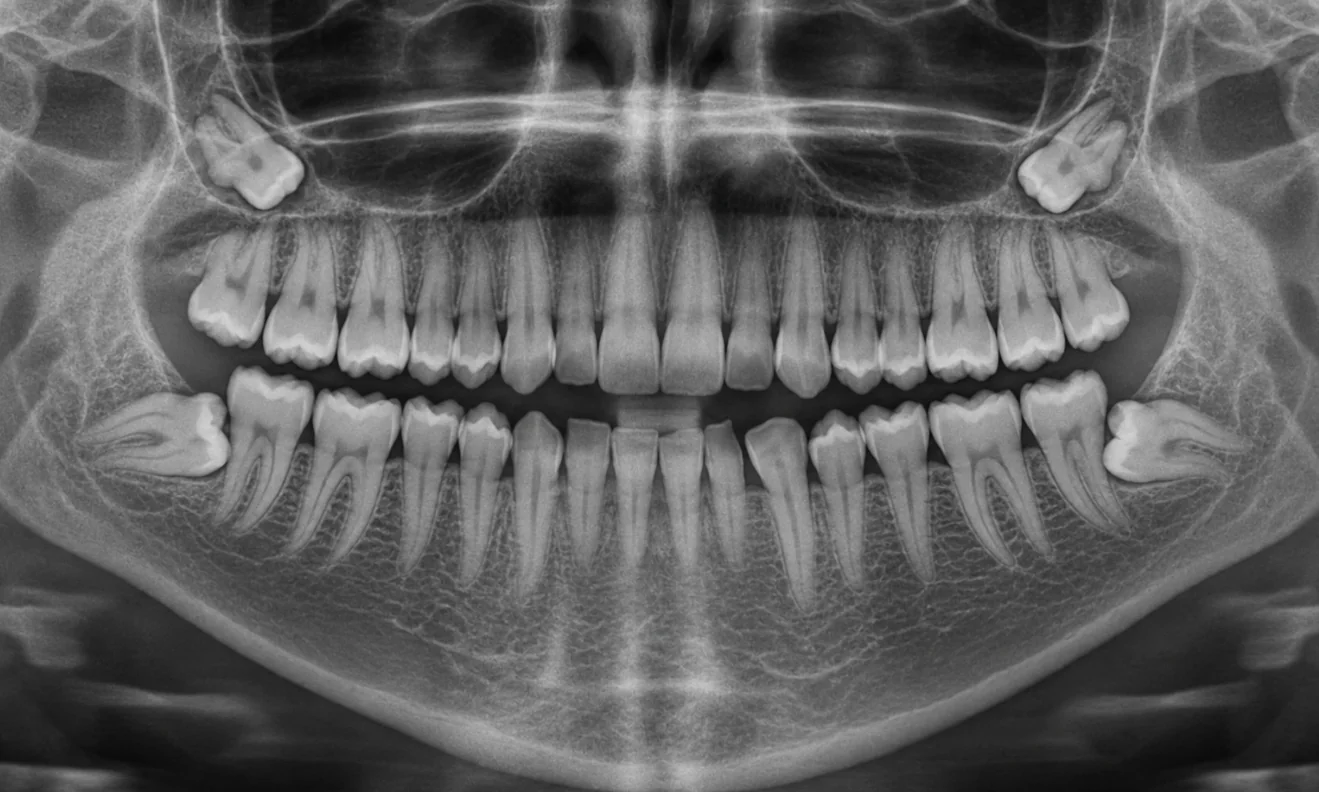
Angled or impacted teeth
A wisdom tooth may tilt toward the second molar, grow horizontally, or remain trapped beneath the gum. Its position can make cleaning difficult and contribute to damage around the neighboring tooth.
Partially covered teeth
When a tooth emerges only partway, a flap of gum tissue may remain over it. Food and bacteria can collect beneath that tissue, causing inflammation or infection called pericoronitis.
Symptoms may include tenderness, swelling, an unpleasant taste, or difficulty opening your mouth.
Decay and gum problems
Wisdom teeth sit far back in the mouth, where brushing and cleaning between teeth can be challenging. Both the wisdom tooth and the adjacent second molar may be affected.
Other findings, such as a cyst associated with an impacted tooth, may also warrant treatment. Wisdom teeth should not automatically be blamed for crowded front teeth; removal is not a guaranteed way to prevent shifting.
Symptoms that deserve an evaluation
Contact our office if you notice:
- Pain or swelling behind your last molar.
- Repeated irritation around a partially erupted tooth.
- A bad taste, discharge, or persistent odor.
- Difficulty chewing or opening your mouth.
- Food repeatedly trapping in the same area.
Trouble breathing or swallowing, or rapidly spreading swelling, requires urgent medical attention.
Sedation options for wisdom teeth removal
Feeling nervous about an extraction is understandable. Dr. Maxson has experience with wisdom teeth treatment and has completed IV moderate sedation training through the University of Southern California, along with training through the Dental Organization for Conscious Sedation, or DOCS. He is also a DOCS member.
Your options depend on your medical history, medications, anxiety level, and the planned procedure.
- Nitrous oxide: Inhaled through a small nasal mask, nitrous oxide can reduce anxiety while you remain awake and responsive.
- IV moderate sedation: Medication delivered through an IV can produce significant relaxation and drowsiness. You remain able to respond purposefully to instructions. Some patients remember little afterward, but sleep and complete amnesia are not guaranteed.
Local anesthetic is also used to numb the treatment area. Sedation helps manage anxiety; it does not replace local pain control.
What happens before and during removal?
Your evaluation includes an examination, medical-history review, and appropriate imaging. Three-dimensional cone-beam imaging may be recommended when additional detail is needed—for example, to assess a tooth’s relationship to a nerve or other structures.
Dr. Maxson discusses the removal plan, alternatives, and relevant risks, including dry socket, infection, and possible nerve or sinus complications. A referral may be recommended when appropriate for the complexity of your case.
An erupted tooth may be removed directly. An impacted tooth may require an incision and removal in sections. Your individual anatomy determines the approach.
For IV sedation, follow the office’s preparation instructions carefully, including eating and drinking restrictions and arranging a responsible adult to accompany you home. Do not change medications without instructions.
What is recovery like?
Soreness, swelling, and limited jaw opening can occur after extraction. Some patients resume lighter activities within several days, while others need longer. Full tissue healing takes more time than returning to school or work.
You will receive instructions for medication, food, oral hygiene, and protecting the extraction sites. Follow those directions rather than assuming recovery will fit into a long weekend.
Contact the office for worsening pain, persistent bleeding, fever, or concerns about healing. Avoid smoking and follow restrictions intended to protect the healing blood clot.
Frequently asked questions
Can I have all four wisdom teeth removed together?
Sometimes. The recommendation depends on each tooth, your health, and the treatment plan.
Can I drive after IV sedation?
No. Arrange an adult escort and follow instructions about driving, work, and supervision afterward.
What will removal cost?
Cost varies with the number and position of teeth, surgical complexity, imaging, and sedation. We will review an individualized estimate.
Ready to understand your wisdom teeth?
Call Calm Dental Care at (408) 996-0176 or request an evaluation with Dr. Douglas R. Maxson in San Jose, CA.