What is a root canal, and why might I need one?
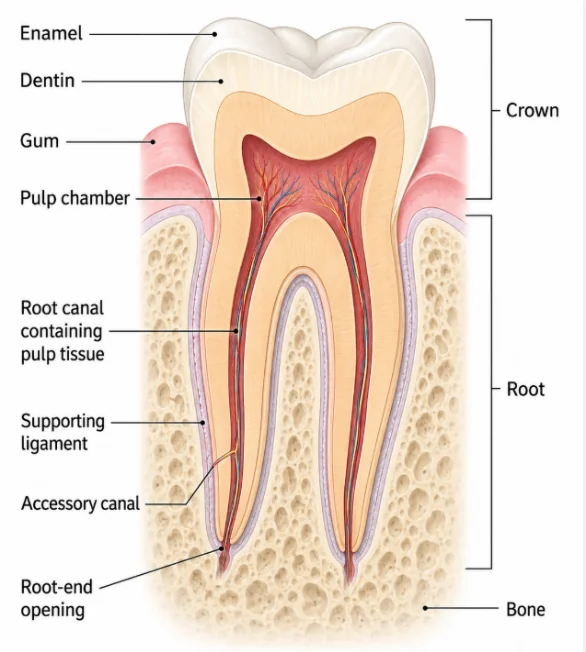
Inside every tooth, beneath the hard outer enamel and dentin, is a soft core called the pulp — the nerve and blood supply that runs down through narrow channels in each root. Depending on the tooth, there may be one canal or as many as three or four. When that pulp becomes inflamed or infected, it can cause pain and, if left alone, an abscess (a pocket of infection) in the bone at the root tip.
The pulp can be damaged by deep decay, a crack or chip, an injury or blow to the tooth, repeated dental work, or a leaking filling — and sometimes for reasons that aren’t clear. A root canal treats the problem while keeping your natural tooth in place. Once a tooth is fully grown, it no longer needs the pulp to stay healthy, so removing the infected tissue relieves the pain without sacrificing the tooth.
What are the signs I might need a root canal?
Common warning signs include:
- Lingering sensitivity to hot or cold that stays after the food or drink is gone
- Pain when biting or chewing, or a deep, spontaneous toothache
- A pimple, bump, or swelling on the gum near the tooth
- Tenderness or swelling in the gum — sometimes with drainage
- A tooth that has darkened, or deep decay you can see or feel
Sometimes there are no symptoms at all. An infection can quietly show up on a dental X-ray as a dark area at the root tip, where it has begun to erode the bone — which is one reason regular exams matter.
Facial swelling with fever needs urgent attention — call 408-996-0176 right away, and never apply heat to a swollen area of the face, since that can help an infection spread. Antibiotics may calm an infection temporarily, but they don’t fix the underlying problem inside the tooth.
What happens during root canal treatment at Calm Dental Care?
A modern root canal is much like having a deep filling placed, and it’s usually completed in one to three visits:
- 1. Exam and imaging. Dr. Maxson reviews the tooth and takes X-rays to map the canals and confirm the diagnosis.
- 2. Numbing. The tooth and surrounding area are fully numbed; sedation is available if you’d prefer to relax through the visit.
- 3. Isolating the tooth. A small protective shield keeps the tooth clean and dry during treatment.
- 4. Cleaning and shaping. A small opening is made in the top of the tooth, and the infected tissue is removed from each canal, which is then cleaned and shaped.
- 5. Filling and sealing. The canals are filled with a rubber-like material and sealed. A temporary or permanent filling closes the opening.
- 6. Restoring the tooth. The tooth is finished with a permanent filling or crown to protect it and return it to full function.
Will I need a crown after a root canal?
Often, yes — especially for molars and premolars that handle heavy chewing, where a crown after a root canal protects the treated tooth from cracking. Some front teeth may need only a filling. Dr. Maxson will recommend the right restoration for your tooth, and can complete the crown in the same office. Learn more on our Dental Crowns page.
Does a root canal hurt? What is recovery like?
For most people, a root canal relieves pain rather than causing it, and with today’s anesthesia the procedure feels about like a routine filling. Dr. Maxson is known for getting teeth thoroughly numb, and sedation options are available for anxious patients. Afterward, the area may be numb for a few hours and a little sore for a day or two — usually well managed with over-the-counter pain relievers. Most patients drive themselves home and return to work or school the same day (arrange a ride if you choose sedation). Favor soft foods at first, and avoid chewing on the tooth until it’s fully restored.
How much does a root canal cost, and does insurance help?
The fee depends on which tooth is treated and how many canals it has — molars are more complex and typically cost more than front teeth. Most dental insurance plans cover a portion of endodontic treatment. In many cases, saving the tooth with a root canal and crown costs less overall than removing it and replacing it with an implant or bridge, which usually means more visits and more expense. Our team is happy to review your estimate and financing options — see Financial Policies & Financing.
Root canal or extraction: which is better?
When a tooth’s nerve is badly infected, the two main options are root canal therapy or removing the tooth and replacing it. Keeping your natural tooth is usually the better choice:
| Factor | Root Canal Therapy | Extraction + Replacement |
|---|---|---|
| Keeps your natural tooth | Yes | No |
| Typical timeline | Often 1–3 visits, plus a crown | Extraction, then weeks–months for an implant or bridge |
| Neighboring teeth | Preserves your normal bite and spacing | Teeth may shift unless the gap is replaced |
| Look and feel | Your own tooth | A very good replacement — but not identical |
| Overall cost and visits | Often fewer visits and lower total cost | Usually more visits and higher total cost |
Figures vary by case. Saving a natural tooth is generally preferred when the tooth can be restored — nothing looks, feels, or functions quite like your own.
Root canal retreatment: a second chance to save the tooth
Now and then, a tooth treated in the past flares up again months or years later — from new decay, a cracked or leaking crown, a fracture, or a narrow, curved canal that couldn’t be reached the first time. Retreatment gives the tooth another chance: it’s reopened, the old filling material is removed, the canals are re-cleaned and re-examined for missed anatomy or lingering infection, then refilled, resealed, and restored. Dr. Maxson offers retreatment for suitable cases. If you’ve had a root canal before and the tooth is aching or tender again, have it evaluated promptly.
Apicoectomy and endodontic surgery
Most infections clear with a standard root canal or retreatment. When infection lingers in the bone at the very tip of the root, a minor surgical procedure called an apicoectomy (root-end resection) can save the tooth. After the area is numbed, the gum is gently opened to reach the root tip, the infected tissue and the end of the root are removed, and a small filling seals the root end; bone-graft material may be placed to help the area heal, and a few sutures close the tissue. Most patients return to normal activities the next day with only mild soreness. Dr. Maxson also performs apicoectomy surgery on teeth that don’t respond to traditional treatment; more complex surgical cases may be co-managed with a trusted endodontic specialist.
Why choose Dr. Maxson for your root canal therapy?
- Experienced in root canal therapy. A general dentist who diagnoses, treats, and restores the tooth from start to finish in one familiar office.
- Gentle, effective numbing. Known for getting teeth fully comfortable, with sedation available for nervous patients.
- A calm, comfort-first approach. The name Calm Dental Care reflects how the team works to ease dental anxiety.
- One team, start to finish. Diagnosis, the root canal, the crown, and follow-up under one roof — no bouncing between offices for routine cases.
- Honest recommendations. When a case is better co-managed with a specialist, Dr. Maxson will tell you.
- Serving the South Bay. Patients from San Jose, Sunnyvale, Santa Clara, Cupertino, and Campbell.
- Digital imaging. More accurate and quicker imaging of your tooth.

Common root canal myths, briefly
- “Root canals cause illness or cancer.” There is no valid scientific evidence linking root canal treatment to cancer or disease elsewhere in the body (source: American Dental Association / American Association of Endodontists).
- “It’s better to just pull the tooth.” Saving your natural tooth is almost always better for your bite, appearance, and long-term cost.
- “No pain means no problem.” A tooth can need treatment without hurting — an X-ray may reveal infection at the root before you feel it.
Ready for relief?
Schedule your root canal consultation
Call Calm Dental Care in San Jose at 408-996-0176 — relief for that tooth starts with one call.
Request An AppointmentNot sure yet?
Request an evaluation and we’ll tell you honestly whether you need treatment.
Ask a QuestionRoot Canal FAQs
Is a root canal painful?
+
With modern anesthesia, most patients find a root canal about as comfortable as a routine filling, and it usually relieves existing pain. Dr. Maxson is experienced at getting teeth fully numb, and sedation is available. Mild soreness for a few days afterward is normal and typically eased with over-the-counter pain relievers.
How many visits does a root canal take?
+
Often one to three visits, depending on the tooth, how many canals it has, and whether infection is present. Back teeth (molars) have more canals and can take a little longer.
Will I need a crown afterward?
+
Often yes — especially for molars and premolars that do heavy chewing, where a crown protects the tooth from fracture. Some front teeth may need only a filling; Dr. Maxson will advise based on your tooth.
Can I drive and go back to work afterward?
+
Yes. Root canals are usually done with local anesthetic, so you can drive and return to normal activities the same day. If you choose sedation, please arrange a ride.
What can I eat after a root canal?
+
Wait until the numbness wears off so you don't bite your cheek or tongue, then favor soft foods for a day or two and avoid chewing on the treated tooth until it's fully restored.
Do I really need a root canal if my tooth doesn't hurt?
+
Sometimes, yes. An infection can appear on an X-ray as a dark area at the root tip even without pain. Treating it early helps prevent a painful flare-up or a spreading infection.
What happens if I don't get it treated?
+
The infection can worsen, form an abscess, and spread to the jaw or face, eventually leading to loss of the tooth. Facial swelling with fever needs urgent care — call right away and never apply heat to the area.
Is a root canal or an extraction better?
+
Keeping your natural tooth is almost always the better choice — nothing looks or functions quite like it. Replacing an extracted tooth with an implant or bridge usually takes more time and often costs more overall.
Author: Douglas R. Maxson, DDS — Calm Dental Care, San Jose, CA · Clinically reviewed by: Douglas R. Maxson, DDS · Last updated: October 1, 2026